Wednesday, April 16, 2014

South Texas Bow Hunting - Rio Grande Turkey


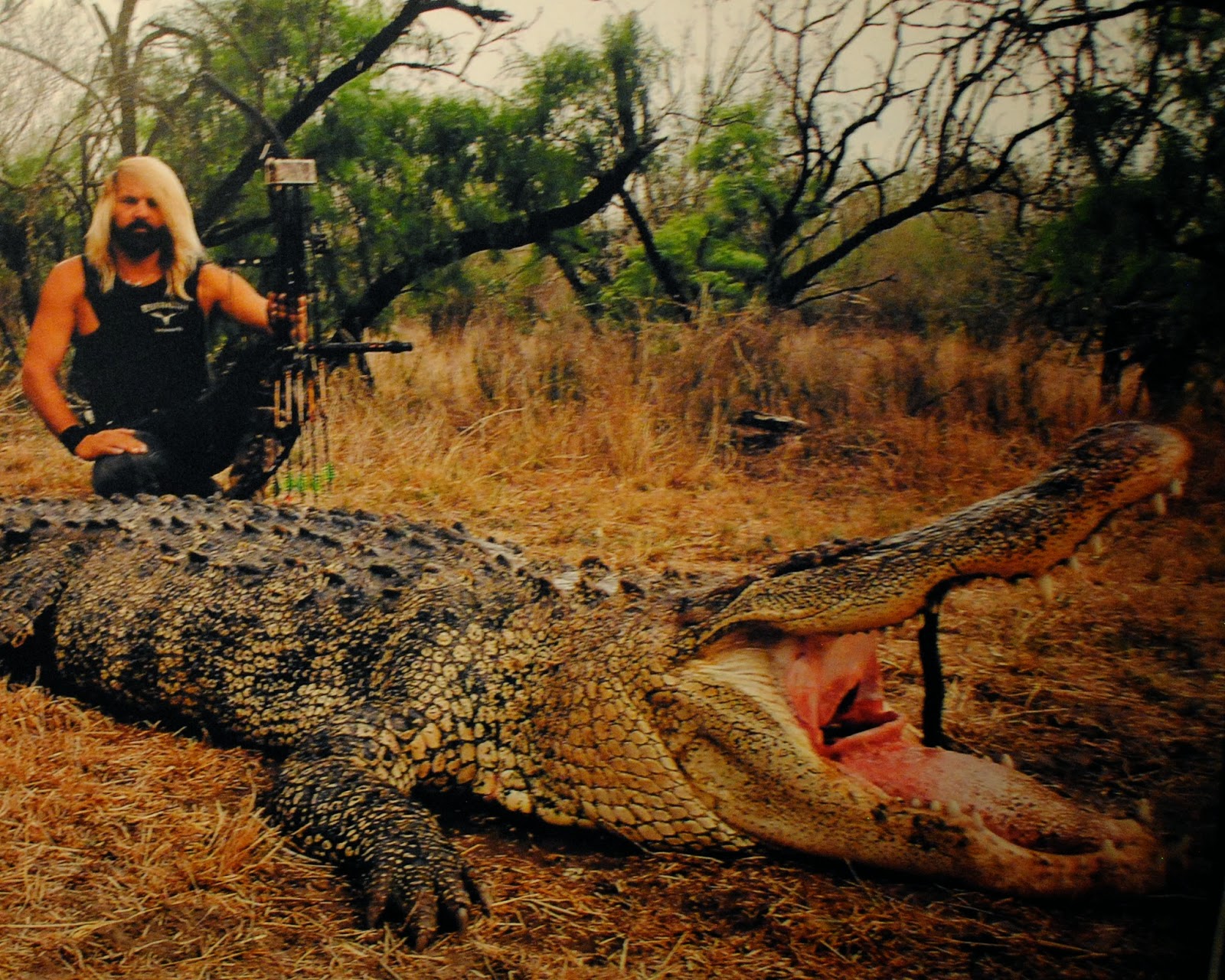
 Bow hunting our South Texas Rio Grande Turkey is one of the hardest things I have ever done for Television.  The main reason it’s so hard, is the simple fact that Turkey can see so well and hear so well.  They are an amazing animal.  They work as a group and communicate to each other.   They have many predators and they are very smart.  

Having a cameraman out there in the field with me makes is two times as hard to get on video.  Another person there is generally not a positive since they move and make noise and I move and make noise.  It’s been two years of trying to get a Turkey with a Bow for TV and it came together with my great friend Buck Medley on the Teal Ranch in McMullen county.
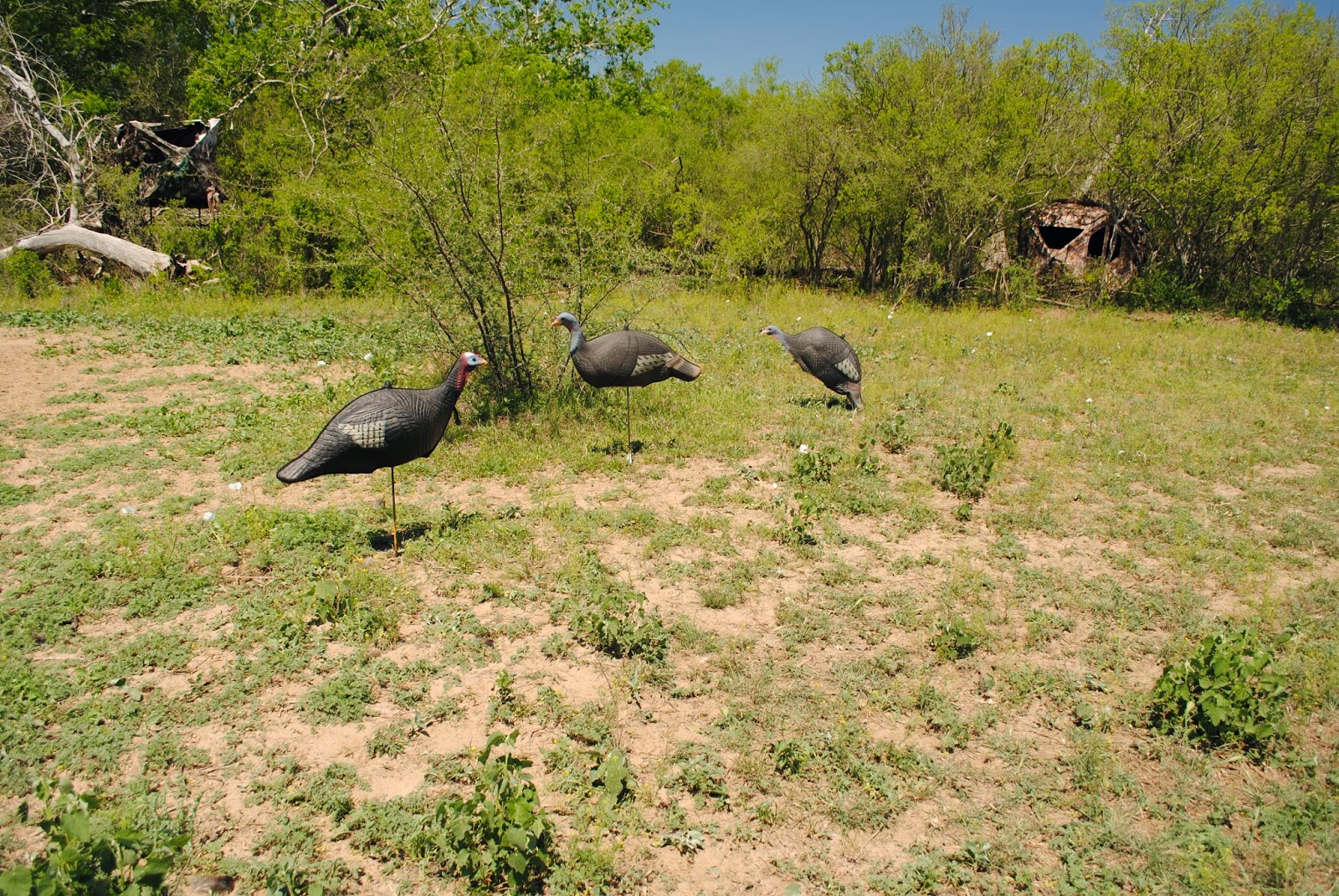


Buck and I decided to set up a Pop-Up Blind deep in some cover with 2 alley ways near us and an open pasture just in front of us.   We used two decoys to make it happen, one was a Hen and the other was a Jake.   They, we had hoped, would draw in those territorial Toms in mating season to our spread.   We had several birds come to our calls.  They flew down from the roost early in the AM hours right in front of us but they were not interested, they landed and stood still like a statue.  They did not move a bit as they surveyed their surroundings.  Then they moved off and did not care for our offering.   Buck and I stayed on the hunt and let things settle down.   We stayed quiet and did not call much.  We did not want to overcall which is a major mistake a lot of people make when they are new at Turkey hunting.

We then had a nice group of Jake’s come in from Left to Right.  This was looking good.  He told me to draw back for a shot, a long shot, about 40 yards.   I held the sights on the Jake I liked and let the arrow fly.    It was a solid hit and the bird went into the woods to the Left of our pasture.   We tracked him down about 75 yards from the field.    That was my first Turkey with a bow. 

Special thanks to Fred and “ The Bow Shop” in San Antonio and Mathews Bows for sponsoring our TV show.  We could not have made it happen without them.   

Okay, with that ----Successful Hunt Completed !   Buck said, “ Let’s get a Big Tom this afternoon”.   That’s exactly what we did.


We eased back into the Pop-Up Blind and stayed super quiet for what felt like 1 hour.  Then Buck began his amazing calling.   Buck is an amazing outdoorsman; he has been on many hunting shows and killed many turkey with a bow.  I was with a great hunter.

We began calling.  Nothing !!   We were there for 2 hours and nothing.   I was getting anxious.   Finally, we had Toms gobbling back at us.  


They were behind us, and they seemed hung up, not coming any closer to us.  They would gobble back to his yelp of a hen call but not come in to our spread.   We were tenacious and kept on our plan to not “over-call” but show these Tom’s that we were a group of Hens and Jakes and they should come in and investigate.   Finally, the returned calls from the Tom’s got louder.  My heart was pounding since they were getting closer and closer and coming in from behind us from our Right.  It was awesome.   This was it !!!
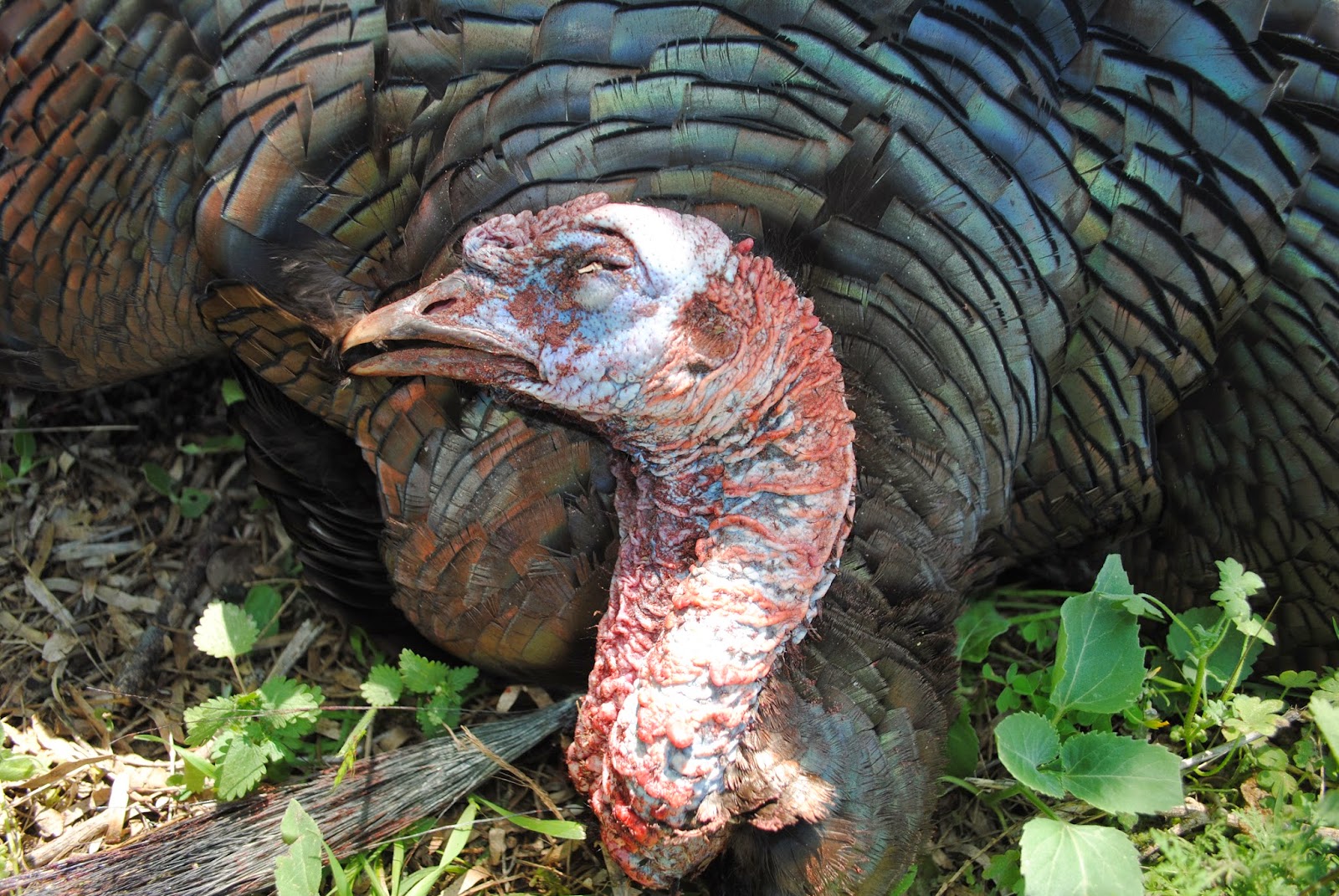


They were not strutting like the Jakes when they came in these Tom’s were closed up and were looking closely at the decoys.  Buck said draw back and stay in back of the blind, don’t let them see you.  I did just that.  I moved my body to the back of the blind, took a knee and put my bow down low and made the draw-back low in the blind.  I then raised up slowly and got the peep on the Tom’s.  Okay I was drawn back but would I get the shot.   Time would tell.

This was it.   Do I get the shot ?  There were 3 of them.  Which one should I target?   Do I have time to work this out?  I am drawn back, Buck is videoing the birds.  “No Pressure”  this is what it is all about.   Buck said “Take the Shot”, Take the Shot” !

I let the arrow fly and hit him in the lower part of the neck, a great shot.   He was flapping around on the ground and I was out of the blind and had him by the legs within 60 seconds.   I wore light weight camo gloves with my trigger finger cut out just for this opportunity.   It was an amazing day.   Two turkey with the bow in one day and Fried Turkey Strips coming tonight.


Cooking Wild Turkey:
Rio Grande Turkey have very dense breast .  They use a lot of mussle mass to Fly and to Open Up a Strut for the mating ritual.  I therefore like to cut the meat into strips, marinade it for 24 hours in a Cajun marinade, to give it some “Flavor” and deep fry it in my Fry Daddy that I use to fry fish.  It comes out great !  The fact that you cut it in strips before marinating it makes more surface area for the marinade to do its work.

Buck and I plan to do some Offshore Spear Fishing out of Port Aransas Texas next for some monster Amberjacks, Tuna and Ling.  Stay tuned, that’s coming up in just a few weeks.

Thanks for your time today and “I’ll See You in The Wide Open Outdoors !!


Dave


Tuesday, February 11, 2014

Snapper Fishing
State and Federal Waters
1-18-2014
written by Capt. Doug Stanford


Snapper fishing can be a great time for anybody .It does not require a lot of tackle .
  The first thing you need to know is the regulations you must follow. You must use a circle hook for snapper in federal waters or  state waters of Texas. I usually go with a 7/0 to 10/0 circle hook. If i am fishing State waters i will go with a 7/0 hook . The state water snapper will be smaller than the ones in federal waters . In State waters we are allowed to keep 4 fish per person 15" or greater. They must be measured overall from mouth to tip of the tail . There is no closed season in Texas State Waters . The state waters of Texas extend 9.2 nautical miles from the shore . Or about 75 ' deep. Anything past that is Federal waters .
  In Federal waters you can only keep 2 fish 16" or greater measured from the tip of mouth to the inside fork of the tail . The season varies and usually only lasts 40 days This is a link to get the most up to date federal regulations:

 ..http://http://sero.nmfs.noaa.gov/sustainable_fisheries/gulf_fisheries/reef_fish/2013/rs_2014_rec/  

Currently :
Federal waters of the Gulf will open to red snapper recreational harvest at 12:01 a.m., June 1, 2014, and close at 12:01 a.m., July 11, 2014.


 With that said . My favorite fishing rig for snapper is a double drop with the weight on the  bottom . I start with a black 150#  swivel tie 100# to 200# mono leader 6' long with a palomar knot . Then drop down 18" and make a surgeon's loop 6". Drop down and tie another 6" surgeon's loop . At the bottom I will tie another surgeon's loop. Tie your fishing line to the swivel .Then take your surgeon's loop and pass it through the eye of your hook go around the shank of the hook 2 times then pull loop tight . Repeat for the next loop down . The bottom loop pass the loop through the eye of a bell sinker and loop it back 1 time . Pull tight on weight to set the line.


 I like to use a 5 to '6' medium heavy rod with a Penn 4/0 reel . Spooled with 50# Trilene Big Game green line . Yes it is more fun to use lighter tackle but these fish will pull you into the structure and break off .
  The bait varies Squid is messy and will stay on your hook longer . It is not always the best bait .Shrimp will catch them the easiest but will come off quicker. Sardines,cigar minnows and menhaden  work well but will come off easily .  Live perch catchers the bigger ones but will not get as many bites .
  I will use  4 oz to 8 oz weight but it will vary with the current. When dropping down keep a watch on your line as it descends . Often the fish will be holding half way down to all the way on the bottom . These are reef fish and love to be near structure ,whether it is a oil rig ,wreck or manmade reef .Please keep only the first legal fish .Do not cull .When bringing these fish up from deep water they will expand and cannot go back down quickly. You are required by law to deflate these fish before releasing. Do not cull .
  Always check the weather before going off shore and have a good working condition VHF radio. Good Luck tight lines and screaming drags .


.http://http://sero.nmfs.noaa.gov/sustainable_fisheries/gulf_fisheries/reef_fish/2013/rs_2014_rec/    

Currently Federal waters of the Gulf will open to red snapper recreational harvest at 12:01 a.m., June 1, 2014, and close at 12:01 a.m., July 11, 2014.

Wednesday, December 18, 2013

Managing White Tail Deer 12-11-13


We shot a great HD Television Show in December of 2013, in Tilden Texas with Megan Gillett. Tim Teal is a great friend of mine and Megan is his daughter. Megan is an avid hunter and she wanted to“Spot and Stalk” a Management deer they had picked out. They really did not want this deer breading in the population on the ranch since he was old and not a superior animal. They are interested in growing bigger deer on the ranch. We were targeting a mature White Tail that was estimated to be over 5.5 years old. We stalked him over two days and finally made the kill. He was a really nice 8 point that weighted 135 lbs field dressed. This was a Pre-Rut hunt and we had a great time making it happen. This was Megan’s best buck to date but she said she is ready to move the bar up and get a 10 point next.


Let’s talk about Managing White Tail populations:

Over the past 30 years, especially the past decade, populations of white-tailed deer (Odocoileus virginianus) have increased dramatically throughout all of the United States. This includes the Northeast and in many Midwestern and western states. Fact---not commonly known---White Tail deer are in New York as well. And, in the 1900s New York’s deer population rebounded from about 20,000 to more than 1 million. There are over 15 million white tail today in the US.

Increases in deer abundance can be attributed to changes in habitat, including reversion of abandoned farm fields to forest, and shifts in human population to rural and suburban areas. Both of these trends have opened forested habitat preferred by deer. Another fact is that, decisions by landowners to prevent hunting have made many areas off limits to hunters, have allowed deer populations to increase.

This growth has had US residents to have mixed feelings. The white-tailed deer is the most widespread and abundant member of the deer family and one of the best recognized large mammals in North America. Whitetailed deer are an amazing component of our wildlife heritage.


They are avidly sought by hunters, photographers, and nature observers.

The buck, or male deer, stands 3 to 3 1/2 feet tall at the shoulder, weighs 125 to 200 pounds, and grows antlers that are shed annually. Does are females and they are smaller and lighter than males and lack antlers.

White-tailed deer breed from mid-September through late February, and the peak of the breeding season, or rut, occurs in November.
Fawns are born in the early summer after a 200-day gestation period. In their first pregnancy, does usually give birth to a single fawn, though twins are common in later years if food is abundant. Bucks begin to develop antlers in April, and the antlers grow until August or early September. The size of the antlers depends primarily on age and nutrition; older bucks typically have larger antlers. Growing antlers are covered with a skin called “velvet.” This skin is covered with soft hairs and contains blood vessels that supply nutrients to the growing antlers. When the antlers stop growing the velvet dries and is shed or rubbed off by the buck as he polishes his antlers on saplings, shrubs, or rocks. Bucks shed their polished antlers each winter in preparation for the
growth of a new set.

High populations of deer may result in numerous deer-vehicle collisions and pose a serious threat to motorists. It is estimated that each year in the United States 29,000 people are injured and more than 200 lose their lives in deer-vehicle collisions.

Wildlife management is important to keep deer population numbers in order. Deer can overpopulate and cause the entire herd to have problems in breeding and in maintaining good health. Shortage in food and shortage in enough terrain per animal can lead to serious issues like disease or malnutrition. The goal in taking animals out is to maintain a healthy population of animals on the ranch.

South Texas ranchers often need to take over 50 does and 20 bucks off their ranch each year to maintain healthy populations. Often the meat is donated to the homeless and other types of shelters where food is a shortage. The meat is excellent.

The night pictures here are of a lesser Management 8 that we harvested on the ranch on an evening hunt.


Thanks for your time and I’ll see you in a “Wide Open Outdoor Adventure”


Dave

Thursday, December 12, 2013

Late October Rod-Bending in Port Aransas 
10-27-13


We left the Port A Marina early in the AM in search of some hot fishing in late October.

I was fishing with my main cameraman Tony Dehoyos. The 24 foot Pure Bay and 300 Suzuki was ready for the challenge.

We fishing the flats early in the morning and found some fish with soft plastics but nothing really to talk about.

After some time of moving short moves of 50 to 100 feet across the flats and surrounding channels and cuts we decided to move to the deeper water of Corpus Christi Bay.

At first we fished the yellow gas platforms and we had no luck, not even a bite on the soft plastics with swimming tails. We tried it slow and fast, deep and shallow and worked the bottom as well, nothing.

We then went to the shorelines and worked the drop, nothing. Okay it was looking like the fish had lockjaw. I wasn’t going to give up. We went into East Flats and threw the throw net and caught some Pony mullet.
We used that for bait and picked up 2 nice 24 plus inch Redfish. Okay, finally something was pulling back on the rods. Maybe the fish were starting to turn on. I then decided that we need to go back to the gas wells and get some Speckled Trout.

Back to Coco Ho Lures with lead Jig Heads. First cast, I got several taps….Nice. Was the bite coming on? The next cast, a nice 13 inch Sand Trout. Not a Game Fish but great eating and no limit. He went into the box, okay finally a keeper on board. Over the next 30 minutes Tony and I worked the gas platform and we had 7 Sand Trout and 2 really nice Gafftop in the box. We then went to several other platforms and …….nothing there.


Last Ditch Effort Pays off:
Okay, what was it about that first gas platform, was there a rock pile on the side like there often is? Was there more current there? Were there bait fish on that structure? Something was different.


On the second cast, It was a hard pull and then steady tension. What was it, a big Stingray ? That is what I thought I had, I was working on the bottom and bumping it up and down as I moved it toward me. I was up on the Yeti ice chest working it with the rod tip low. Okay, big something, but what?


I had to use the 36 Volt Minn Kota to chase her and get my line back. I was using 30 LB Power Pro Braded line. Finally I was making some headway and bringing her up. It was a massive Bull Red. She measured over 53 inches long and 41 pounds. She was 25 inches in Girth. This was the biggest Bull I had caught on a soft plastic 3
inch lure…..ever.


She went back to fight again and since she was Breeding Stock she will be part of making more big fish for future anglers. Normally these big big fish are offshore. We were over 11 miles from the Surf and open water. Hopefully she is on her way there now. Thanks for your time and-----“I’ll See You On the Water!!”

Dave